


Business process: A set of linked activities that achieve a business objective within an organisational structure (e.g. an insurance claim, contract approval, holiday request, purchase request). A process may sit in one unit or span several organisations.
Workflow: The automation of a business process, in whole or part, where documents, information or tasks pass between participants according to procedural rules.
Workflow automation: Software that runs a business process defined in a Process Plan — its activities, rules and control data — and manages the workflow as it runs.
CWP is a web-based, self-service, user-friendly enterprise workflow platform for automating processes and managing documents. Digitise paper-based activities into step-by-step processes that follow your policies — with real-time, collaborative eForms and tasks, accessible anywhere. Ideal for multi-language and cross-border operations thanks to built-in language switching.

1. Sign in
For a demo you get a dedicated web address and login. Buy a licence and we install CWP on your infrastructure free of charge; buy SaaS and we make you a system admin.
2. Design your process map

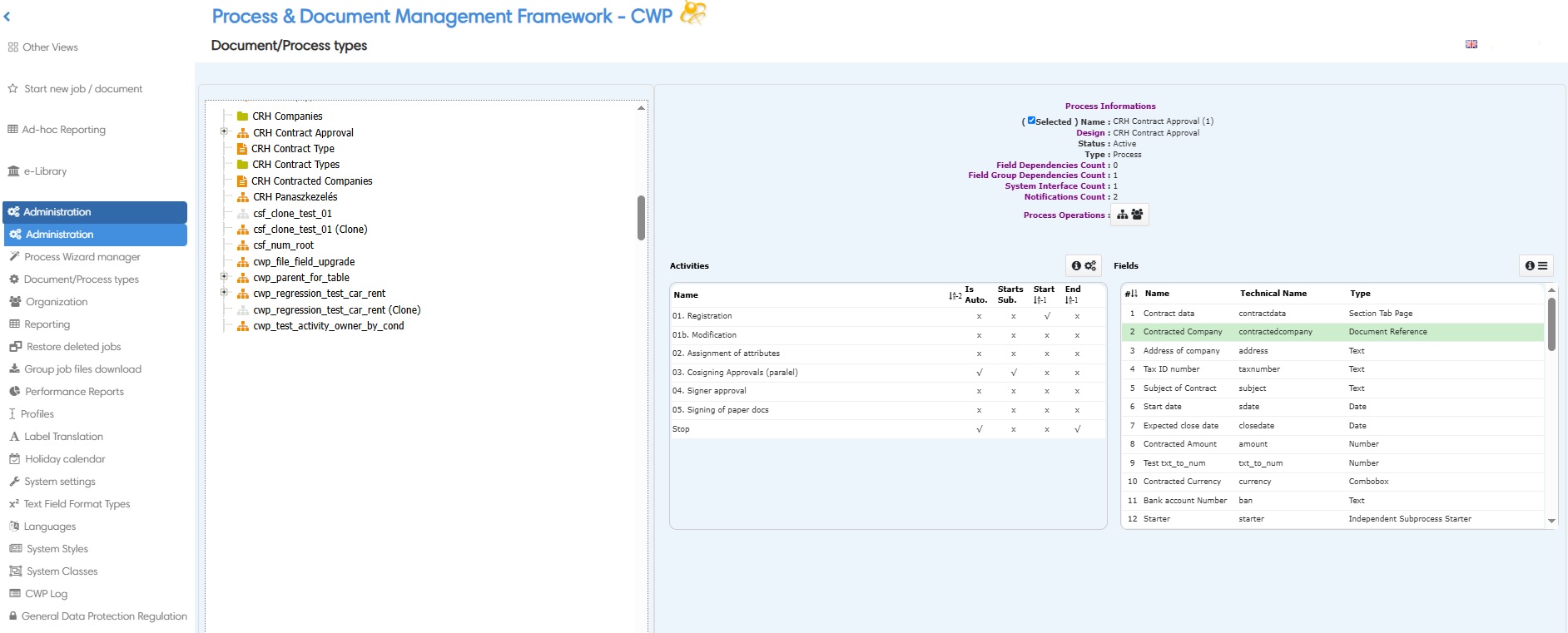
Administration > Document/Process Types > Import Process Design. Draw the process in the built-in designer or import from MS Visio, QPR ProcessGuide or ARIS (the built-in designer is recommended to avoid step/routing issues). CWP is multi-language; set designs up in your main language.
3. Add users, departments and roles
Administration > Organization > Persons/Department/Roles. Add users (name, title, contact, IDs, password) and build an org hierarchy of any depth; import from Active Directory (AD Sync won't overwrite CWP admins). Use roles to assign step owners so processes don't need editing when people change jobs.
4. Create a process type & category

Administration > Document/Process Types > Manage Categories, then create a new Document/Process Type: choose the flowchart design, name, technical/short name, category and position. New processes start passive until activated. Example categories: IT, HR, Purchasing, Customer service.
5. Define eForm fields, visibility and layout
Add fields per process (right-click the process type > Fields), set per-step visibility via the Activities > Fields column (or in the graphic designer), and arrange fields on the responsive 12-column form.
6. Set routing, owners and notifications
Configure step transitions and conditions (Activities > Routings), dynamic routings where users choose the path, step owners (person/role/department), and email notifications and SLAs per step using your own templates.
7. Activate
Administration > Advanced Operations > Activate. The process status shows active or passive. Other settings: database connections, system interfaces, WordMerge documents and the holiday calendar.
Create statistical, progress and performance reports with rich filters (running dates, process/field/type, owner and more). Features: Excel export, calculated-field reports, graphical process history, scheduled/automatic reports, a change-by-change audit trail, and CWP log reports.
Every plan includes all features — workflow, document management, reporting, and audit trail — with unlimited users and processes. Choose a perpetual license or a subscription.


